Dejar un mensaje
Si le interesan nuestros productos y desea obtener más información, deje un mensaje aquí y le responderemos lo antes posible.
Pigment for Nail Gel: Film Thickness Sets the Size Ceiling
A nail product is 10–100 µm of dry film. This page shows how film thickness, cut size and pigment loading set the ceiling, and why the swatch never matches.
The swatch on your desk is not a standard colour. It is a record of three numbers held at once: dry film thickness, flake size, and pigment loading. None of the three is printed on the card, which is why the card cannot be copied by swapping powders. This page gives the lower and the upper limit of each one.
A card that reads green at one angle and pink at another was fixed on three quantities before the camera clicked. Dry film thickness decided how much room the flake had. Flake size decided which grade went in. Loading decided how many flakes sit in a cubic millimetre. Move any one and the photograph stops describing your jar.
The card carries none of the three. It carries a colour, a light angle and a hand. That is how two formulators end up holding the same swatch and producing two different films — not because either bought the wrong pigment, but because the swatch never named the film it was drawn from.
Base colour is a fourth quantity, and it is the one most often confused with the other three. It does not decide whether a flake fits inside the film. It decides how much of the flake's own colour survives the trip back to the eye. The base reflects a spectrum of light, and that reflection combines with the flake's selective reflection in the colour you see.
Film thickness and loading tend to drift slowly, because both are pinned by a house recipe someone already wrote down. Flake size can change within a purchase order if a substitute grade is accepted without checking its cut range. Before reading any card, check which grade each powder is cut to across the pigment range used for nail work.
That listing is the first place the three numbers separate: the same chemistry appears at several cut sizes, and each cut size needs checking against the intended film. A grade that reads correct in one house line can read chalky in the next.
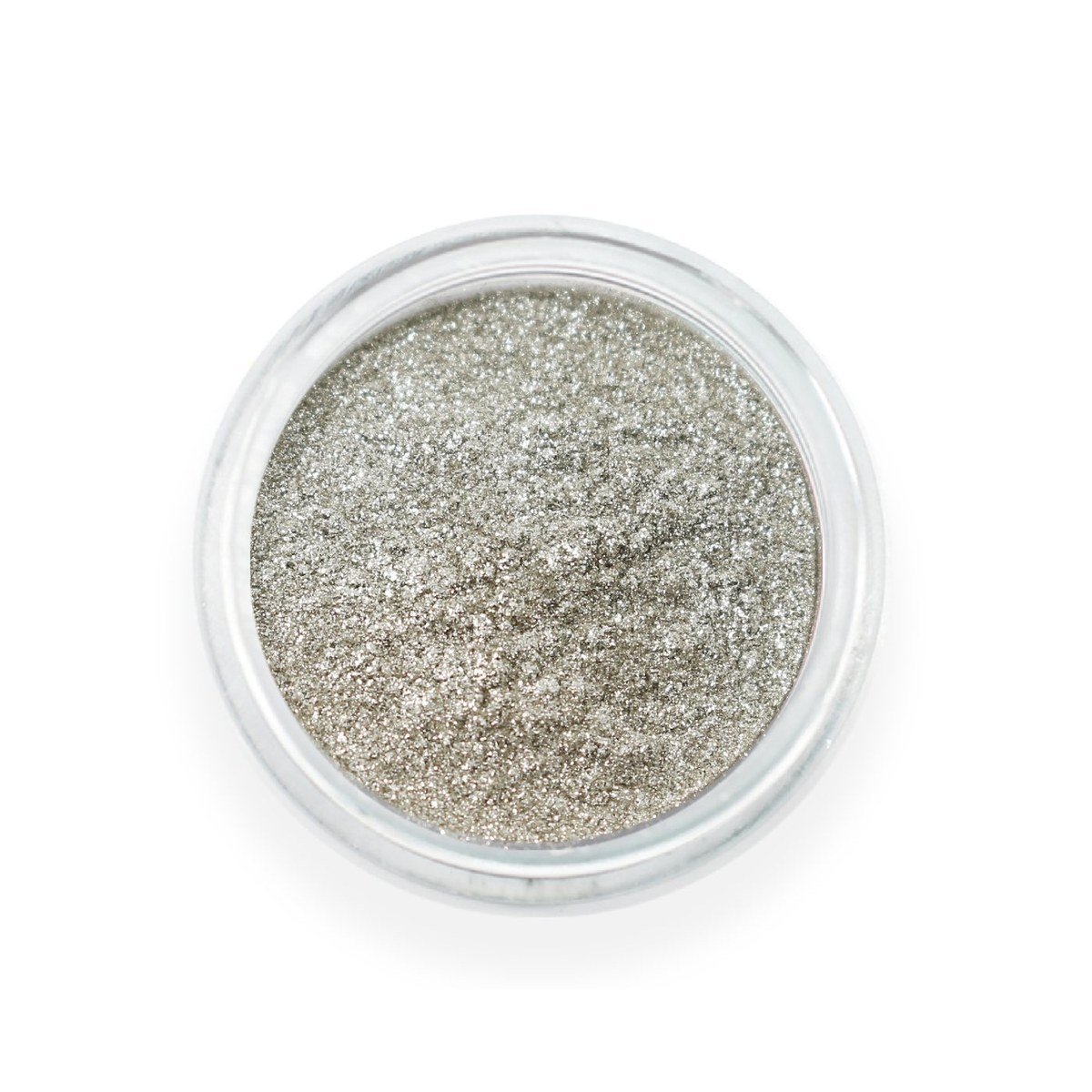
Figure 1 — KT-89204A, a fine cut, in an open jar. At this cut the plates sit well inside a normal gel film.
Dry film sets the available room, and it is not a wide band. The reference dry film range for nail polish, gel, dipping powder and acrylic is 10–100 µm after drying or curing. A flake whose thickness exceeds the film cannot be fully enclosed in it, because there is not enough space through the film to hold it flat. This is geometry, not formulation.
The dimension that matters for enclosure is the flake's extent through the film, not simply its quoted cut size. A platelet lying flat occupies its own thickness; one caught on edge can occupy much more. That standing edge reads as texture on a coarse grade and as a scratch on a fine one, from the same chemistry.
Four systems, one reference band, four routes into it. The split between those four systems comes down to carrier: solvent-borne polish, UV gel, dipping powder cut 55–110 µm across the KT-DP002–043 range, and acrylic cut 60–110 µm across KT-AC01–27.
The dipping and acrylic powder ranges describe the starting particles, not the final film thickness. They cannot be compared with a thin gel coat as though every particle retained its original shape and orientation. Before you shortlist a grade, measure the dried or cured film on your own line, not the wet coat on the spec sheet.
Loading does not buy room back. Ten percent of a 200 µm grade is still the same particle size; reducing the amount does not make an oversized or poorly oriented particle fit. Thickness and cut size have to be settled as a pair before loading is worth discussing at all.
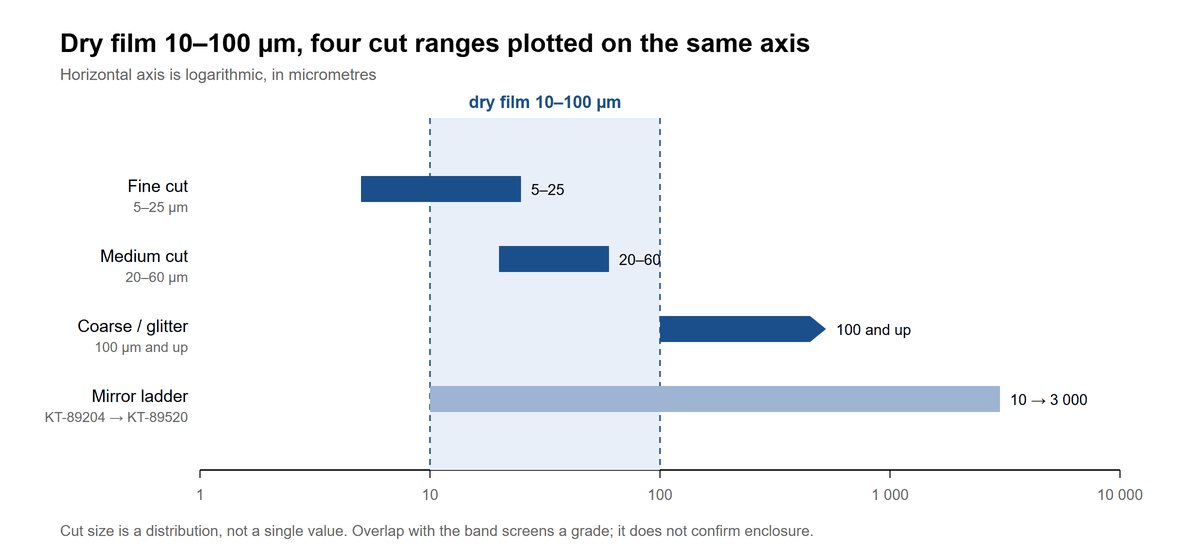
Figure 2 — A nail product runs 10 to 100 µm dry; the cut ranges are plotted across that band. A plate larger than the film has nowhere to sit.
Three numbers, one line each
Thickness is the room: 10–100 µm dry film as a reference, with each platelet's thickness and orientation checked against it.
Cut size is the occupant: 5–25 µm fine, 20–60 µm medium, 100 µm and up coarse.
Loading is the headcount: 0.5–10 % is a general effect-pigment reference, with separate ranges for cat eye, acrylic and dipping powder.
Cut size is quoted as a range because a mill produces a distribution, not a single number. A 20–60 µm grade contains a distribution within that range; the range alone does not locate its peak. The larger particles can be what a customer notices first. Three bands provide a starting point for nail use, and the band you pick is a statement about your film, not about your shade.
Fine runs 5–25 µm. It supports even brushing with less visible drag and less individually resolved sparkle — you see more of its colour than its edge. Medium runs 20–60 µm: visible sparkle at the surface, with suitable magnetic grades used for a cat-eye line under the magnet.
Coarse runs 100 µm and up. At that size, lateral particle dimensions reach or exceed the reference film band, so orientation and surface texture need particular attention. Glitter gives larger individual flashes, and raised texture may be deliberate. If the flake cannot be enclosed in the intended film, reconsider the application method.
For a suitable mirror powder, the alternative method is rub-on. Cure the clear seal coat to a no-wipe finish, work 100 % powder into the surface with an applicator, then seal it. Nothing is suspended in the underlying coat, so its thickness is no longer the enclosure limit. Check the sealed surface rather than assuming every 200 µm grade will behave identically.
The ladder shows how far a cut range can travel inside one chemistry: grades in the same family run from 10 µm at the fine end to well past a millimetre at the coarse end, so the coarsest are three times the reference film band before they are even considered. Which of them can be enclosed in the film you actually run is a separate question, and the cut range alone never answers it.
Before ordering, decide whether the effect goes inside the film or onto it. The grade follows that decision; it does not lead it. A 200 µm mirror-powder order intended for a thin film needs a rub-on assessment rather than an assumption that it will suspend smoothly.
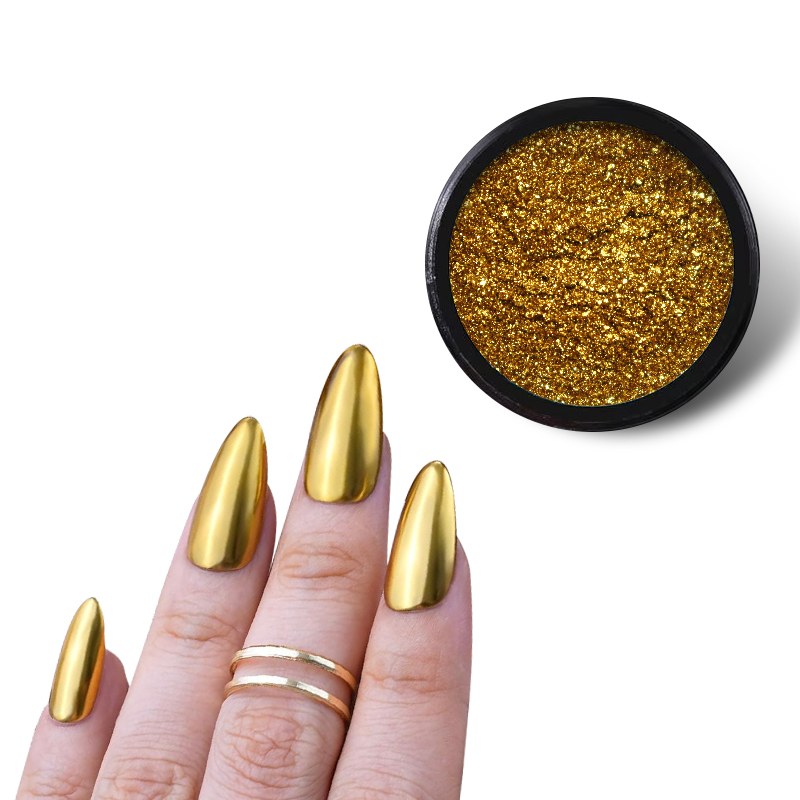
Figure 3 — A rub-on finish on a full set, with the grade that produced it. No film thickness to accommodate: the plate sits on a cured surface instead of inside one.
Loading needs a stated calculation basis, which makes it the least portable of the three numbers. It does not travel between systems, and it barely travels between two suppliers' versions of the same system. The general effect-pigment reference is 0.5–10 %, but cat-eye, acrylic and dipping systems have separate ranges that extend beyond it.
Solvent-borne polish, solid shade: 0.5–5 %. Solvent-borne polish, effect shade: 2–10 %. UV gel: 1–8 %. Cat-eye grades: 10–20 %, with a stronger magnet needed. Acrylic and dipping powder: 30–100 %, where the powder can form the body of the system rather than a small addition to it. Confirm the percentage basis before comparing these figures.
The same sentence — add 10 % — means four different things across those rows. In a solid polish it exceeds the stated reference range. In acrylic it is below the stated powder range. Quoting a loading without naming the system and calculation basis tells the buyer little about what they will see on the tip.
Cat eye needs the magnetic step and cure settings agreed together. The magnet sits 2–5 mm from the wet film for 5–15 seconds, and the UV wavelength range is 365–405 nm. The line can drift while the film remains mobile; check that your magnetic step and curing process hold the intended pattern.
Fine grades generally settle more slowly, but resistance to hard-caking still needs checking in the formulation. Evaluate rheology modifiers — bentonite, fumed silica — against both settling and application behaviour. Confirm solvent resistance before fixing a grade: ethyl acetate, butyl acetate, isopropanol and acetone do not treat a coated flake identically.
Fix the system first, then the loading, then check the grade still sits inside the film. The order matters, because a loading chosen before the system is a guess — and usually a guess made without a clear calculation basis.
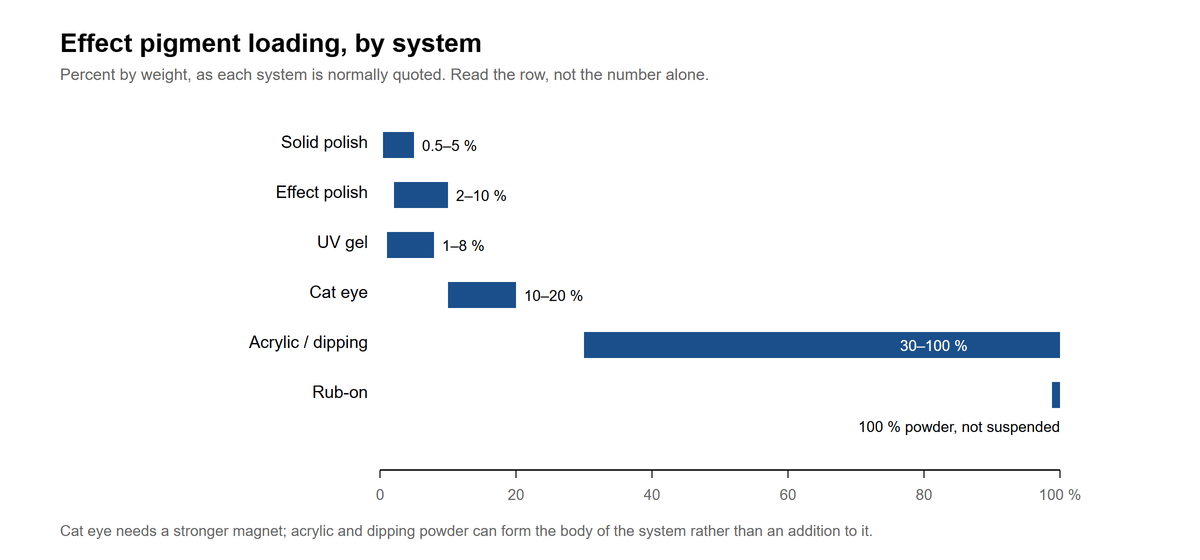
Figure 4 — Loading ranges by system, from solid polish at 0.5 to 5 % to dipping powder at 30 to 100 %.
An interference flake is partly transparent. What reaches the eye includes light selectively reflected by its layers and light transmitted through the coating and reflected by the base. A pale base returns a broad spectrum of light, and that background reflection can reduce the contrast of the interference colour produced by the flake.
That is why the same powder can read flat on a white tip and saturated on a deep one. The film can be identical in both cases — same grade, same loading, same thickness. The base changed the balance of reflected light, not the pigment.
Deep base plus two to three thin coats is the reference arrangement for bringing out the effect. Thin matters because each coat needs to dry or cure properly before the next goes on; a heavy coat can dry or cure unevenly, depending on the system.
Angle-shifting colour is a different question from base colour and is covered once in chameleon pigments for colour-shift nail finishes rather than here. The base decides how much of the shift survives; the shift itself is a property of the flake's layer stack.
Lay out tips — pale, mid, deep — with the exact film you run, and keep them beside the swatch book. If the card only matches the deep one, check whether it was made on a deep base before changing the powder. Compare the tips under consistent lighting and viewing angles so that a lighting difference does not become a formulation decision.
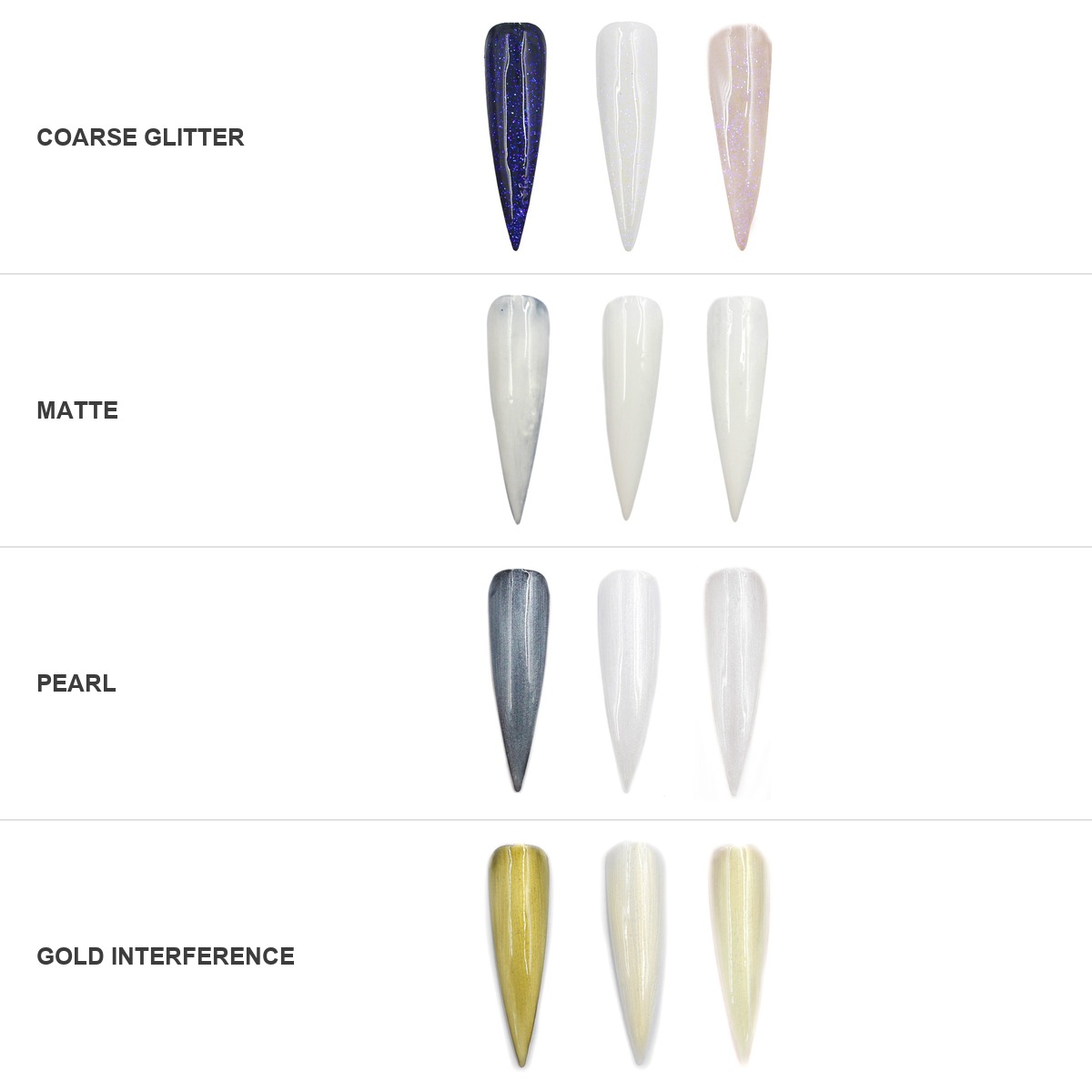
Figure 5 — Four systems, each on a dark, a mid and a pale base. Top to bottom: coarse glitter, matte, pearl, gold interference. The base moves the reading in every row; the row-to-row difference is the system.
Put the three together and the card becomes a more reproducible reference, provided the base, lighting and viewing conditions also agree. The table below brings the page together: the reference range for each variable, and what needs checking when your film or formulation moves beyond it.
| Variable | Lower reference | Upper reference | Beyond the reference |
|---|---|---|---|
| Dry film thickness | 10 µm | 100 µm | Outside this reference band, validate drying or curing and the finished effect; thickness alone does not establish a failure. |
| Flake cut size | 5 µm, the lower end of the fine range | Validated against film thickness, platelet thickness and orientation | Particles that cannot be enclosed can protrude or create uneven texture; assess suitable mirror grades as rub-on at 100 % powder. |
| Effect pigment loading | 0.5 % general reference; system-specific ranges differ | 10 % general reference; cat eye, acrylic and dipping powder have separate ranges | Beyond the applicable system range, check opacity, flow, platelet alignment and drying or curing rather than assuming a universal failure point. |
Read it top to bottom against the film you actually dry or cure. Thickness and cut size need checking together, but they describe different dimensions of a platelet and its surroundings. Loading becomes useful once the grade and its orientation have been checked against the intended film.
Three numbers go on the enquiry: dry film thickness in µm, the cut range you want, and the intended pigment loading with its calculation basis. Name the system the powder will be carried in as well. Add the base colour you intend to shoot on if the card is the reference.
Use Pearl Pigment Color Cards as a colour reference, then request confirmation of the cut range for the shade you are considering so that the grade is recorded in your specification.
Write the three numbers into your own spec sheet before the next order. A grade quoted without the film it is going into cannot be checked by anyone, on either side of the desk.
Do not assume it will suspend smoothly in a 10–100 µm dry film: the quoted lateral size does not establish platelet thickness or orientation. For a suitable rub-on grade, cure a no-wipe clear coat, rub in 100 % powder, then seal. For suspension, start with the 5–25 µm band and validate the finish.
A pale base reflects a broad spectrum of light, and that return can swamp the interference colour from a translucent flake. A deep base with two to three thin coats helps bring out the effect. Confirm the card's base and application conditions before you change the powder.
Gel carries 1–8 %. Solid solvent-borne polish carries 0.5–5 %, effect polish 2–10 %, cat eye 10–20 %, acrylic and dipping powder 30–100 %. The same 10 % exceeds the solid-polish reference but falls below the acrylic powder reference; confirm the calculation basis for each system.
It gives a larger single point of sparkle and more surface texture, not a brighter colour. The cost is brush drag, lifting at the edge and uneven coverage — and the flake still has to fit the film. Past that point texture is the product.
Send your dry film thickness, the cut range you are considering and the intended loading with its calculation basis. Name the system it will be carried in and request a custom sample pack built around your system. Tell us your solvent conditions and base colour so the enquiry describes the film you intend to test.
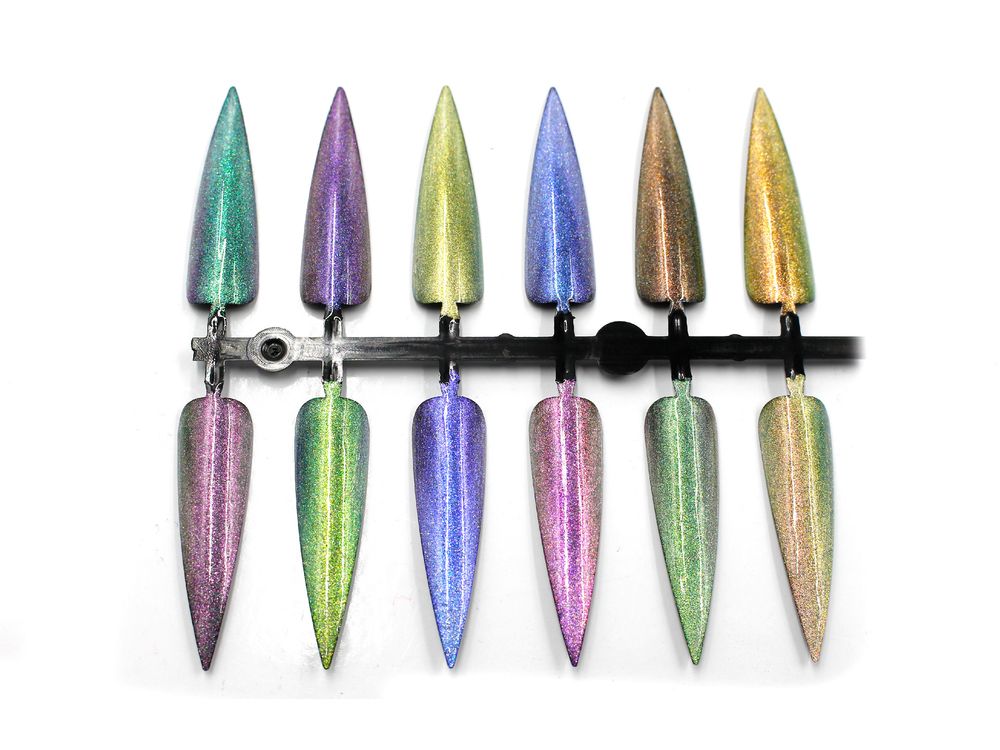
Los pedidos al por mayor de pigmentos holográficos Aurora para decoración de uñas requieren que la serie adecuada se ajuste al método de aplicación correcto: frotamiento, suspensión en gel o esmalte de uñas. En Kolortek, nuestras series CandyPlus Aurora (ARS21**/ARS31**) y Candy Aurora (ARS6***), resistentes a los solventes, están diseñadas específicamente para la suspensión en esmalte de uñas, mientras que nuestras gamas más amplias Aurora y Holográficas se adaptan a las técnicas de frotamiento y gel. Como proveedor directo de pigmentos iridiscentes con más de 20 años de experiencia en producción, enviamos pigmentos holográficos y aurora de grado cosmético al por mayor a formuladores y marcas de uñas en más de 100 países.
LEER MÁS
 Español
 English
 Français
 Deutsch
 Русский
 Português