Why Aluminium Flakes Float or Stay Inside the Film
Read one silver panel at two angles and it gives two different readings. The crown comes back bright; twenty degrees off, it goes flat and grey. Nothing about the metal changed between those readings. What changed is which way the flakes face, and that was settled while the film was still wet, by a fatty acid left on the flake surface.
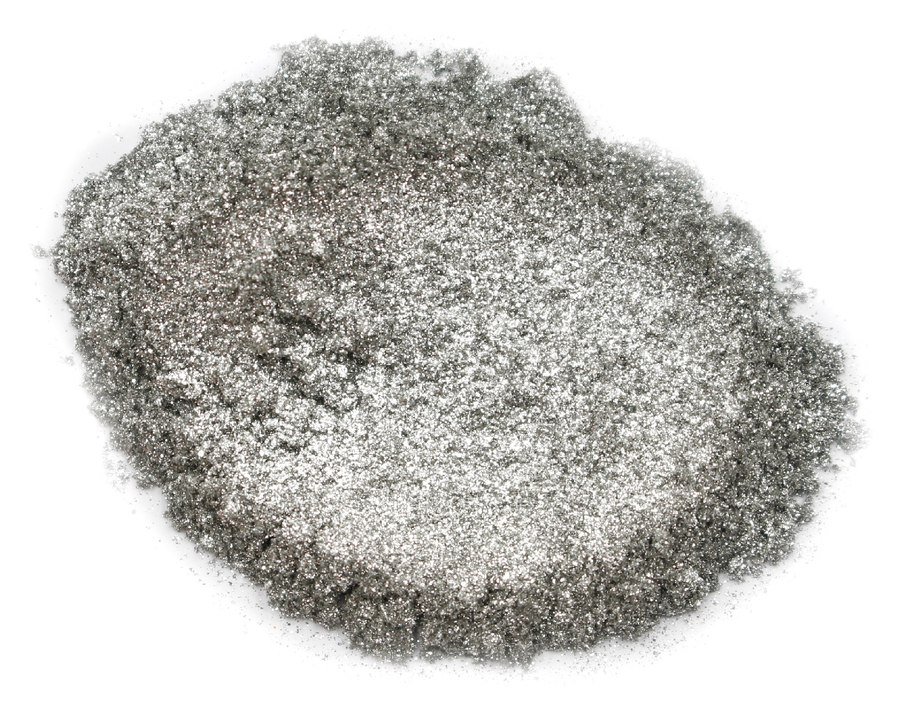
Fig. 1 — Aluminium flake powder as it ships. Every particle is a thin platelet, and how those platelets stack in the dry film is what the rest of this page is about.
Two panels, one bucket of flake
Same lot, same substrate, two films. One reads as a mirror at near-specular angles; the other reads as satin and falls away sooner as you rotate the panel. The reflex is to blame the pigment — a finer cut, another grade, a higher load. None of those is the lever that moved.
What moved is where each flake ended up across the film thickness. In the mirror panel the flakes are stacked at the film–air interface, overlapping like roof tiles. In the satin panel they sit scattered through the film, each one wetted by resin.
That position is set while the film is still wet and fixed as it dries or cures. No dispersant or rheology modifier turns it back afterwards.
The lubricant left on the flake sets the direction
Aluminium pigment is not mined as flake. Aluminium grit, a hydrocarbon solvent and a lubricant go into a ball mill, and the milling flattens the grit into platelets. In powder-coating production the solvent is driven off downstream, but the lubricant stays on the flake. That residue thickness is measured in nanometres and decides everything below.
Use a saturated fatty acid, stearic acid being the standard choice. The flake then carries a dense non-polar tail layer and has low surface energy, so the resin cannot wet it. As the binder gels, the flakes migrate to the coating–air interface, crowd together, lie flat and overlap. Parallel and packed at the surface, they leave very few scattering centres on the light path, and gloss reads at its highest.
Use an unsaturated fatty acid instead, oleic acid being the common one. That surface is wettable. Resin wets it, wraps it, and holds it roughly where the flow left it, so the flakes end up distributed through the film at whatever orientation the application gave them.
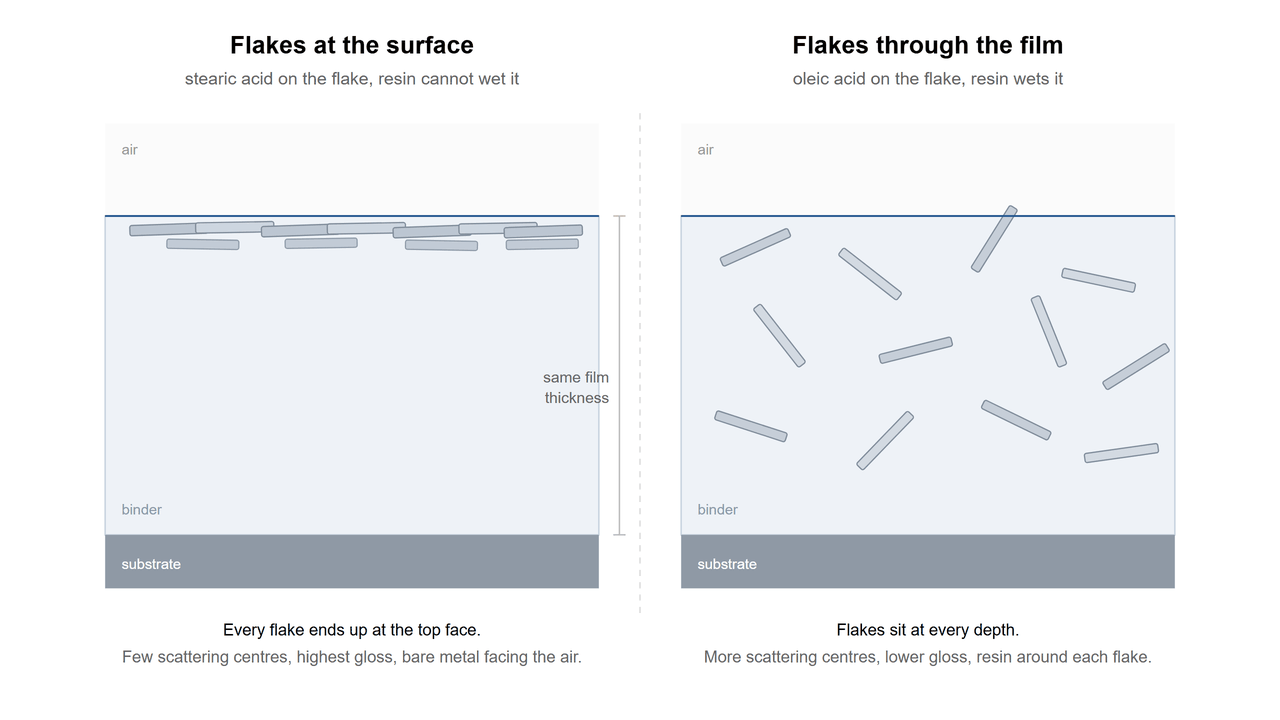
Fig. 2 — Same film thickness, same flake count. Left: flakes stacked at the film–air interface. Right: flakes dispersed through the film and wetted by resin. (illustrative)
What the flake position changes in the reading
| Reading |
Flake at the surface |
Flake through the film |
| Face brightness |
Highest of the two |
A step lower |
| Side tone, flop |
Strong, dark flanks |
Compressed |
| Opacity at a given build |
High |
Needs more pigment |
| Surface wear |
Flake is the outermost thing |
Resin sits over the flake |
| Solvent window |
Narrow: polar solvents break the float |
Wider |
Read the brightness rows together. For the same pigment, the flake-through-film version is lower in brightness, lower in flop and lower in gloss; the surface version wins all three. The cause is the count of scattering centres on the light path, not the metal. Flakes stacked flat at the surface present fewer edges, so more of what returns is specular.
The opacity rows are the cost side. Flakes crowded at the surface hide the substrate with less pigment, so the surface version reaches the same opacity at a lower load; a flake-through-film grade closes the gap with more pigment. Price that before you quote.
The same shift shows up wherever orientation goes wrong. In injection-moulded parts, misaligned flakes are a recognised cause of appearance defects, which is why the effect is modelled before tooling.[3]
Orientation is not a fixed property of the powder. Spraying panels under different conditions produces coatings with measurably different flake orientation, and single flakes can be read under laser scanning confocal microscopy to see which way they lie.[1] Change gun distance, atomisation or film build and you move the orientation before you touch the pigment.
Powder systems work the same lever from the other end. A bonding step attaches flake to resin particles, and longer bonding time drives the flakes toward parallel with the surface, with a continuous film forming at 100 °C in the cited study.[2]
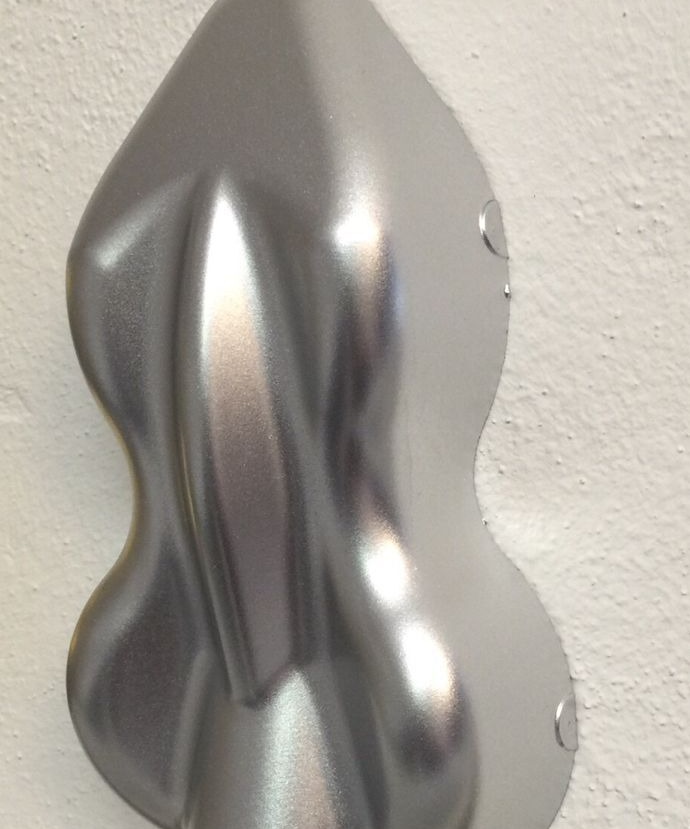
Fig. 3 — A silver speed-shape panel. The bright band along the crown and the darker flanks are one coating read at two angles.
What the surface position costs you
The surface version has one cost and it is mechanical. With the flakes concentrated at the interface, the outermost material on the part is pigment, not binder. That layer scratches and soils more readily, because no resin sits above the flake to take the damage first.
Whether that matters turns on one question, and it is not about appearance: is there anything above this film when the part is finished? If a clearcoat, a lamination adhesive, a transfer or any second operation follows, the flakes at the surface are what those steps have to survive. If the film is the finished face and the brief is maximum brightness, the surface version is the right buy.
The honest test is local. Build a panel, overcoat half of it with a clear layer from your own system, and read gloss and distinctness of image on both halves. Whatever gap you measure is the cost, in your resin, at your film build. The weathering route you chose also feeds into this comparison, which is covered in our note on powder coating weathering.
How to check a grade before you order
Float test. Dust a little powder onto clean water in a shallow dish. A grade with a strong surface tendency spreads, floats and knits into a continuous film. A grade that sinks and disperses is being wetted by the water. Neither result is a defect; both are information.
Solvent check. Alcohols, ketones and water attack the float; low-polarity solvents preserve it. If your let-down carries a polar component, run the test in that let-down rather than in a generic solvent.
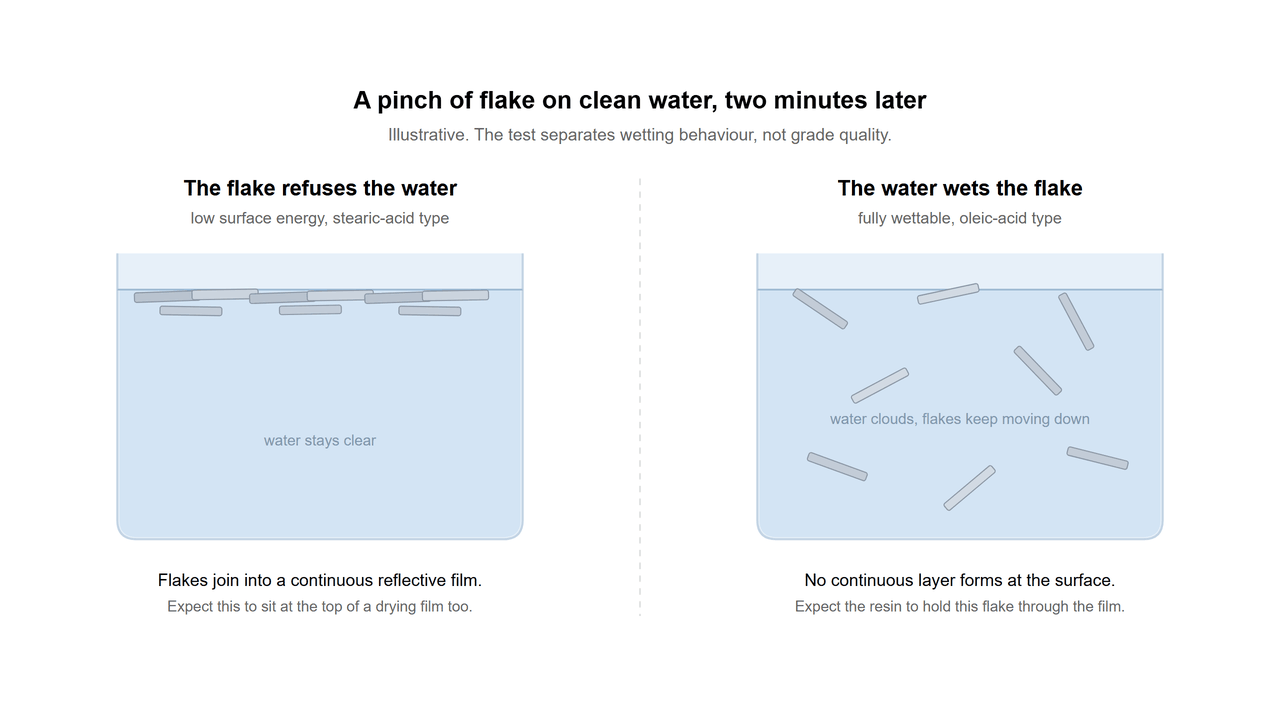
Fig. 4 — Float test on still water. Left: flake spreads and knits into a film at the surface. Right: flake wets out and keeps moving down. (illustrative)
Sourcing and Ordering
Cuts are 15–45, 35–75, 55–75 and 55–145 μm. Which one fits follows from the film build you can hold and the flop you need. The catalogue does not class each grade as leafing or non-leafing, so confirm the behaviour on the grade's TDS before the film is built. The plant is ISO 9001:2015 certified; other certificates are provided on request. MOQ is confirmed per grade and destination port. The full range, with the face-and-eye-use statement, is in the Aluminum Pigment Powders catalogue (PDF), and the powder-and-paste overview sits on our aluminium pigment range page.
Frequently Asked Questions
I changed my spray distance and the silver came out different. Is the powder at fault?
No. Orientation responds to application conditions.[1] Fix spray parameters and film build first, then compare pigments on matched panels.
Can I clearcoat over the brightest grade?
The useful question is what happens when you do, not whether you may. Overcoat half a panel from the same system, read gloss on both halves, and measure the gap before you commit to the specification.
The floating grade covers better. Can I add less?
Yes, and the saving converts into flakes exposed at the surface. Cost the film by what it has to survive, not by price per kilo.
Send Us the Film, Not Just the Colour
Three facts shorten the enquiry: the film system, whether anything sits above the film at the end of the line, and whether the target reads mirror or satin. Send a coated panel if you have one. Send us the film system and the next step and we will answer on the side of the trade-off that fits.
References
- Sung, L.-P.; Nadal, M. E.; McKnight, M. E.; Marx, E.; Laurenti, B., "Optical Reflectance of Metallic Coatings: Effect of Aluminum Flake Orientation", Journal of Coatings Technology, 2002, 74(932). NIST publication. https://www.nist.gov/node/603136
- Gunde, M. K.; Kunaver, M.; Hrovat, A.; Cvelbar, U., "Bonding process efficiency and Al-flake orientation during the curing of powder coatings", Progress in Organic Coatings, 2005, 54(2), 113-119. doi:10.1016/j.porgcoat.2005.05.002
- Sasayama, T.; Okamoto, H.; Sato, N.; Kawada, J., "Numerical simulation of plate-like particle orientation in injection molding", Powder Technology, 2022. doi:10.1016/j.powtec.2022.117481

 Español
 English
 Français
 Deutsch
 Русский
 Português